
Score betting in New Zealand: the only legal channel, the offers behind it, and how the odds are built
 Available in US
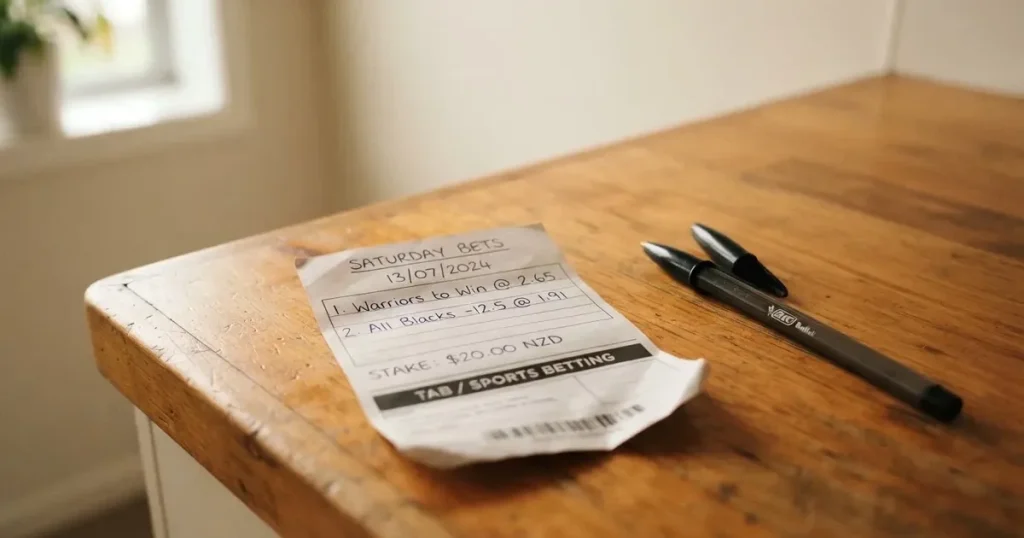
Score betting in New Zealand does not look like score betting anywhere else, because there is no longer a market in the ordinary sense. Since the Racing Industry Amendment Act2025 took effect on 28 June 2025, TAB NZ and its online sister brand Betcha are the only operators allowed to take online sports and racing bets from a person in New Zealand. Anyone searching for a shortlist, a comparison, or a list of apps that offer score bets lands here first needs the regulatory shape before the picks — because the picks are, in practice, two brands from one company. The rest of the page explains what score betting actually means, what those two brands do with it, what offshore names a New Zealand punter meets in marketing and at the cashier, and how the margin in any price quietly sets the cost of every wager.
Currency as of October 30, 2026 against the public register and brand-side terms; the section 74AAA prohibition is the legal frame and has not been re-opened.
The 2025 amendment and the shape of the New Zealand market
A single line in the Racing Industry Act 2020 has done the work of an entire regulator. Section 74AAA, inserted by the Racing Industry Amendment Act 2025 and in force from 28 June 2025, says that no person other than TAB NZ may offer racing betting, sports betting, or other racing or sports betting to a person in New Zealand — regardless of where that person is resident or incorporated. The Department of Internal Affairs told providers serving New Zealand to withdraw with immediate effect on the day the section came into force, and there is no licence to apply for and no licence register for bookmakers, because there is only one lawful provider. The greyhound racing code is being closed in stages from 1 August 2026, and from that date offshore operators may not take bets on greyhound races either; for every other code and every other sport, the prohibition already covers events held inside and outside New Zealand.

TAB NZ is run by Entain under a 25-year partnership signed in 2023. Entain takes a 50/50 share of gross profits; at least $150 million a year flows back to TAB NZ for the first five years; Entain also made a one-off $100 million payment to the racing sector on signing. That structure is why the two consumer-facing brands — TAB at tab.co.nz and Betcha at betcha.co.nz — share an app stack, a wallet, a safer-gambling framework and a back office. The Online Casino Gambling Act 2026, which opened a route for online casino licences in 2026, does not extend the betting monopoly: TAB NZ winning the right to apply for a casino licence does not give anyone else the right to take a sports bet from a New Zealand resident, and the casino framework is separate from the betting prohibition in any case.
A few consequences follow from this shape. A New Zealand resident cannot open a betting account with a brand named anywhere else without using a non-New Zealand identity, because TAB NZ accounts require a verified New Zealand address and ID; the law targets the operator, not the player, and section 19(4) of the Gambling Act 2003 says a player cannot be convicted for placing a bet with an offshore operator in breach of section 74AAA. New Zealand does not block offshore websites; the law puts the liability on the operator and leaves the player with whatever recourse that operator’s own terms and that operator’s home regulator provide. The point-of-consumption charge on offshore racing and sports bets ceased on 30 June 2026; from that date, the operator’s exposure under the duty does not change the prohibition, because a duty being payable is not a permission to take the bet.
Responsible gambling under section 74AAAA market with one lawful operator still has a safer-gambling layer, and the layer belongs to TAB NZ. The TAB NZ app lists deposit limits, time-outs and self-exclusion as in-account tools, and an exclusion applies across both brands — TAB and Betcha — because they sit on the same account infrastructure. The helpline is the free New Zealand Gambling Helpline at 0800 654 655, with a text line on 8006, and Safer Gambling Aotearoa is the umbrella service. The age for TAB NZ betting is 18 — section 89 of the Racing Industry Act 2020 makes betting under 18 an offence — even though land-based casinos set their own age at 20, and the two thresholds are never the same number. There is no single national online-betting exclusion register; the register the 2026 casino law will require covers online casinos only, not the betting side.
The cost of the harm-minimisation layer sits with the operator. TAB NZ pays a Problem Gambling Levy of 0.74%, in force from 1 July 2025 to 30 June 2028, into the Ministry of Health’s gambling-harm services. Offshore operators serving New Zealand residents do not pay this levy because they do not, in the eyes of DIA, lawfully serve New Zealand at all; what they offer is whatever harm-minimisation their home regulator and their own house rules provide, which may be nothing. DIA’s published warning to New Zealand residents about offshore operators lists three specific risks: the operator may sit in a jurisdiction with minimal consumer safeguards, may not return unspent credits, and may not pay out large wins. None of those risks is theoretical; all three are exactly what an offshore dispute looks like when the dispute goes badly.

A punter using either TAB NZ brand inherits the New Zealand framework — the helpline, the levy, the in-app tools, the regulator with a name and an office. A punter using any other brand inherits whatever that brand’s footer says, and that is the whole difference between the two routes.
What score betting actually covers, in this market and any other
“Score betting” is the umbrella term for wagers whose selection is a number — the exact final score, a total above or below a line, both teams to score, the first goalscorer, the score at half-time, the score after the first innings. The shapes vary by sport and by bookmaker, but the underlying idea is constant: the bet is settled on a count, not on who wins. Correct score is the cleanest example: a single selection of one exact scoreline (2–1, 1–0, 3–2 and so on), settled on the result after full time, with each scoreline priced separately because each one has a different probability. Both teams to score (often shortened to BTTS) is a binary cousin — a yes/no market on whether each side scores at least once — and it lives on the same fixture as the correct-score grid, priced separately, settled on the same final scoreline. Score anytime, first goalscorer, last goalscorer, score in a half, score in an interval of minutes (the live equivalent of “next goal in the next ten minutes”) all fall under the same umbrella.
TAB NZ’s published betting rules describe a different vocabulary, drawn from racing: Win, Place, Each Way, Quinella, Exacta, Trifecta, First Four, Double, Treble, Daily Double, Running Double, Quaddie and Big6 are all tote-style or fixed-odds racing bets, and the sports-betting menu adds Same Game Multis (a multi whose legs all come from one match), Same Race Multis, Mega Multi bonus on multis that fall short by a set number of legs, Place Extra on selected races, and one-tap Popular Multis. The names vary, the mechanics do not — every multi multiplies the odds of the legs into one price, every leg has to land for the multi to pay, and any leg that voids usually voids the whole multi unless the bookmaker’s own rules carve out an exception (some Bet Builder sites, including Sportaza, void the whole slip if any one selection voids, which is the rule to read before betting).
Live betting adds a second layer. A live score bet is a bet struck after the event has started, priced on the score as it stands. The market moves with the match: a goal at 1–0 changes the price of 1–0, of 2–0, of any correct-score selection that includes the next goal, and of both teams to score. TAB NZ lists live betting in its apps; the in-play product the rules define is whatever the app’s pre-match product is, repriced, with markets added and removed as the match evolves. The audit treats live score betting as a venue, not a new bet type.
The numbers behind every price: the margin and the payout
Every price a bookmaker quotes carries a margin. The margin is the share of every dollar wagered that the bookmaker keeps, on average, across all outcomes of a market; the rest is returned to bettors as payouts. The arithmetic is straightforward: take the implied probabilities of every outcome (1 ÷ odds), sum them, and subtract from 1. For a two-way market priced 1.90 / 1.90, the sum is 1/1.90 + 1/1.90 = 1.0526, which means the payout share is 1 ÷ 1.0526 = 95.0% and the margin is 5.0% — meaning the market returns 95.0% of stakes to bettors as payouts and keeps the rest. State the result as a band, not a single figure: a perfectly symmetric1.90/1.90 is illustrative and the margin moves with every price change, but the band that surrounds a typical soccer1X2 sits between roughly 3% and 8% depending on the bookmaker, the league and when the price is taken. A market at the low end of that band is the cheapest the bettor can buy; a market at the high end is the most expensive.
The payout formula is the other half. A bet of $100 at decimal odds 2.10 returns $210 if it wins ($100 × 2.10), with a net profit of $110 ($100 × (2.10 − 1)). A combination bet multiplies the odds of the legs into one price: a three-leg multi at 1.80, 2.20 and 1.95 prices at 1.80 × 2.20 × 1.95 = 7.722, and a $10 stake pays $77.22 if all three legs win. The arithmetic is the same on every bookmaker; the price differs because the margin differs. A market with more outcomes carries a higher arithmetic sum at fair prices and so a higher margin at the same per-leg mark-up — correct score, with anything from six to sixteen possible scorelines depending on the sport, is one of the most expensive markets on the book, and both teams to score, with only two outcomes, is one of the cheapest.
Bonuses, free bets and what they actually cost
A New Zealand punter looking for a score-bet offer is, in practice, looking at TAB NZ’s in-app Bonus Cash and at whatever the offshore brands market to anyone with a New Zealand IP. The shape of the offer, and the cost of clearing it, vary by brand and by promotion, and the two cleanest distinctions are between a cash bonus and a free bet. A cash bonus pays the stake and the winnings back as cash; a free bet usually pays the winnings only, with the stake returned only if the bookmaker’s own terms say so. A free bet at $20 placed at odds of 3.00 wins $40 if it lands (the $20 stake is not paid back on top), and the average value of that free bet is $20 × (3.00 − 1) ÷ 3.00 × the market’s payout share — for a market with a 95% payout share, the average value is $20 × 0.6667 × 0.95 = roughly $12.67, which is the honest number to put on the offer.
TAB NZ’s Bonus Cash can be split across multiple bets and is the closest thing the legal market has to a deposit bonus. The Mega Multi bonus offers up to $50 in Bonus Cash when a multi of four or more legs falls short by a set number of legs, which is the bookmaker’s own terms for the bonus and is the rule that decides what the bonus pays — falling short by one leg pays a different Bonus Cash amount from falling short by two, and the table the app publishes is the table to read. The terms say “Bonus Cash” carries its own conditions and the wagering rules attached to it vary by promotion; the wagering factor, the minimum price for a qualifying bet, the deadline and the cap on winnings from Bonus Cash are all promotion-specific and are read off the in-app terms each time a promotion changes.
Offshore brands, none of which may lawfully take a New Zealand customer’s bet, publish welcome offers that look larger. Telbet’s welcome offer, on its Russian-language site, is 200% up to 1 BTC plus 50 free spins and a 5 USDT free bet; LegendPlay lists a First Deposit Bonus, a Weekly Reload Bonus, a Sport Jackpot, a Virtual Sports Excitement promotion and an Acca Boost; BillyBets runs cashback, reload bonuses and a coin shop where coins earned through depositing, betting, tournaments and challenges can be exchanged for free bets and free spins, with a five-level VIP programme layered on top. Each of these is described in the brand’s own terms; none of them is offered to a New Zealand resident under the law, and the wagering factor, the minimum price for qualifying bets and the cap on free-bet winnings are all written into the small print that the offer page links to. The dominant pattern — a deposit match with a high percentage, free spins on top, a VIP ladder to keep depositing — is the offshore template, and the template is what the New Zealand rules are designed to keep out of the local market.
The TAB NZ and Betcha apps, side by side
TAB NZ’s app — listed on the New Zealand App Store as TAB – Racing & Sports Betting under the seller name New Zealand Racing Board, first released on 8 September 2014 — covers horse and harness racing, rugby union and rugby league and a wider sports menu pre-match and live, with a 17+ App Store age rating while stating that customers must be 18 or over to bet. Inside the app, Same Race Multis and Same Game Multis sit beside one-tap Popular Multis; the Place Extra option lets punters back runners to finish up to 10th in selected races; Trackside delivers live race streaming with in-app betting; and racing-form, Blackbook and Jockey Challenge tools sit beside a simplified wallet for deposits and withdrawals. New customers receive Bonus Cash that can be split across multiple bets, and the in-app terms set the wagering factor and the qualifying markets for any specific promotion.
Betcha, the second of TAB NZ’s two consumer-facing brands, positions itself differently inside the same wrapper. The Betcha app carries a daily Toolbox of odds boosts and insurance tools for bets that do not land, a Bet Social section where punters chat, follow tipsters and share bets or pools, and a Playbook with tips and match analysis. The licence is identical to TAB’s; the safer-gambling tools are identical because they share the account; the only thing that changes is the surface — the daily Toolbox cadence, the social layer, the editorial tempo — and the buyer is a punter who wants a more social product or a different in-app rhythm. Treat them as one operator with two product skins, because that is what they are.
For a New Zealand resident choosing between the two brands, the question is which surface suits a particular punting style. The TAB app is the heavier product — the racing-form depth, the Trackside streaming, the Place Extra option, the multi builder for serious bettors. The Betcha app is the lighter product — the daily Toolbox, the social layer, the tipster follow, the short-form match analysis. They share a wallet, a deposit limit and a self-exclusion, and any safer-gambling setting made on one applies on both.
Live betting and cash-out on the legal market
Live betting is in both apps. A live score bet is a wager struck after the match has started, priced on the score as it stands, settled on the final score after the full event. The TAB NZ menu lists live markets alongside pre-match markets for rugby, racing and the wider sports set; Betcha’s live menu follows the same fixture list with its own daily Toolbox running on top. In-play on a correct-score market is volatile: a single goal moves the price of every correct-score selection that includes the next goal, and the margin on a live correct-score market tends to be wider than the margin on the pre-match equivalent because the bookmaker’s model is updating in real time.
Cash-out is a separate feature that lets a punter lock in a profit or a loss before settlement, accepting a bookmaker-priced amount at the moment the cash-out is accepted. Several offshore brands publish cash-out terms: Sportaza offers cash-out before an event or market is finalised, RTbet fixes the cash-out amount at the moment the punter accepts and does not guarantee the feature is always available, and Alawin’s terms note that partial cash-out is supported but is not available on free bets or risk-free bets. TAB NZ’s published terms describe cash-out as an in-product feature; the rules behind the button — what fraction of the current theoretical payout is offered, what markets are eligible, how a voided leg affects the cash-out value — are written into the app’s own terms. The honest framing: a cash-out price is the bookmaker’s offer of a small slice of the current theoretical payout, not a guaranteed hedge, and reading the feature’s terms before relying on it is the only preparation that works.
Strategy and what a sensible reader does with it
A punting strategy is a bankroll plan before it is a tip list. The mechanics: set a unit size that is a small fraction of the bankroll (one to two per cent is the standard), decide which markets you bet (correct score and BTTS in football are the two score-betting staples, and each carries a different margin profile), record every wager with the price and the stake, and review the closing line — the price at kick-off, which is the market’s best estimate of true probability — to see whether the bets you struck earlier had positive expected value. The model behind the strategy is unchanged across sports; the sport-by-sport calibration is the work.
The market-by-market caveat: correct score is expensive in margin terms and pays out rarely, so the bankroll moves slowly and a run of near-misses is normal. Both teams to score is cheaper in margin terms and pays out more often, so the bankroll moves faster but the edge on each wager is smaller. A multi is the most volatile: every leg multiplies the price and the probability of winning drops with each added leg, so the variance is high and the bankroll needs a long memory. The bookmaker does not need a punter to win to make money; the margin does that on its own, and a punting strategy is the discipline that decides how much of the margin a punter is willing to pay for the chance of a big payout.
No system beats the margin in the long run, and any claim of one is the marketing shape of the same idea. A punting strategy is the set of rules that decides when to bet, how much to stake and when to walk away; the strategy is not a predictor of who wins. The honest edge a bettor can have is a model that prices a market better than the bookmaker’s model, applied to markets with thin margins and disciplined staking; that edge is small, it is hard work, and it is not on the marketing page.
Football and the codes score betting meets
Football is the biggest single market for correct-score and BTTS, and the biggest market in the Premier League, the Champions League and the major European leagues — the leagues the price-comparison sites track and the leagues the offshore brands list first. The fixture density is the reason: matches every few days through the season, a settled score after ninety minutes, a price grid the bookmaker maintains for every fixture. Same Game Multis are the football-specific score bet the app stack leans on, and the SGM mechanic — every leg comes from one match, every leg has to land, the leg either voids the slip or stays in depending on the bookmaker’s rule — is the rule the SGM page in the app spells out.
TAB NZ’s sports menu is anchored on New Zealand and Australian codes — rugby union, rugby league, the All Blacks, Super Rugby Pacific, the NRL, the Black Caps, the Warriors — with the racing codes on top. The Melbourne Cup and Cup Day are the racing dates the punter-side calendar turns on. A score bet on a rugby match settles on the final score; a score bet on a cricket match settles on the score at the end of the innings (or the match, depending on the market); a score bet on a basketball match settles on the final points total. The mechanic is the same; the score-grid is different, and the bookmaker’s pricing reflects the sport’s scoring rate. A basketball game at 110–105 has a different score distribution from a football game at 2–1, and the price grid is built on that distribution.
The punter with a horse-racing habit and the punter with a football habit use different score bets. The racing punter uses Win, Place, Each Way, Quinella, Exacta, Trifecta, First Four and the multi-stack. The football punter uses correct score, BTTS, score in a half, score in an interval of minutes and Same Game Multi. The two punting styles share a wallet on the legal market; they do not share a price grid, and the product page for each sport carries its own grid in its own app.
The offshore names a New Zealand punter meets
New Zealand readers see offshore brands in advertising, in social media, in sponsorship and in app stores. None of them may lawfully take a New Zealand bet; the law targets the operator; the law does not block the website. The brands below are described for what their own terms say about them, not for what they offer New Zealand residents, and the New Zealand status column is the only one that matters for the legal frame. Each brand is rated by the same criteria; none is recommended for a New Zealand punter.
The landscape at a glance
| Brand | New Zealand status | What the operator’s own terms state |
|---|---|---|
| TAB | TAB NZ brand — the only lawful online channel for racing and sports in New Zealand | Racing and sports betting, pre-match and live, with racing-form tools, Trackside streaming, multis and Bonus Cash |
| Betcha | TAB NZ brand — the only lawful online channel for racing and sports in New Zealand | Racing and sports betting with a daily Toolbox of odds boosts and insurance, a Bet Social section and a Playbook of tips and match analysis |
| Roobet | Not licensed in New Zealand | Crypto casino and sportsbook under a Curaçao licence (OGL/2024/687/0427), holder Raw Entertainment B.V. |
| Glorion | Not licensed in New Zealand | Live chat and email support, customers over 18 only |
| Golden Panda | Not licensed in New Zealand | Dedicated Sports Terms covering fixed-odds betting, Combo Bets, Bet Builder, live scoreboards, broadcasts, stake and odds limits |
| Sportaza | Not licensed in New Zealand | Cash out before settlement, Bet Builder with a void-the-whole-slip rule on any void selection, multiples, Asian lines, 1/5/10/15-minute interval markets |
| RoyalistPlay | Not licensed in New Zealand | Tobique Gaming Commission e-gaming licence No. 0000002, holder Novatrix SRL, six odds formats and an English-NZ site version |
| Telbet | Not licensed in New Zealand | Crypto casino and sportsbook, welcome offer 200% up to 1 BTC plus 50 free spins and a 5 USDT free bet on the Russian-language site |
| Rabona | Not licensed in New Zealand | Curaçao licence, launched 23 December 2019 as the sixth Soft2Bet sportsbook |
| Winz.io | Not licensed in New Zealand | Anjouan and Tobique licences stated in the footer |
The two lawful rows sit at the top; the eight offshore rows below them are the names a New Zealand punter meets in marketing. The New Zealand status column is the one that decides who can take the bet; the operator’s own terms column is what each brand publishes about its product. Reading the table from the top: the two lawful brands are the only legal channel; the eight offshore brands are what their own terms describe, with no New Zealand licence behind any of them.
Operator write-ups
TAB — the racing-and-sports backbone of the legal market
TAB is the heavier of TAB NZ’s two consumer-facing brands and is the one a punter opens for racing-form depth, Trackside streaming and a Same Race Multi builder. The product covers horse and harness racing, rugby union and rugby league and the wider sports menu, pre-match and live, with Place Extra on selected races letting a punter back a runner to finish up to 10th and a Popular Multis shortcut for a one-tap multi. The app is listed as TAB – Racing & Sports Betting under the seller name New Zealand Racing Board, first released on 8 September 2014; the safer-gambling layer — deposit limits, time-outs, self-exclusion — is built in; the helpline is the New Zealand Gambling Helpline at 0800 654 655 and the text line on 8006.
The cost of the product is the margin in every price; the gain is the framework around it. A punter choosing TAB is choosing the New Zealand harm-minimisation layer, the regulator with a name and an office, and the dividend dollars paid out within New Zealand rather than waiting on an offshore operator’s terms. The honest trade-off is product depth versus product tempo: TAB is the deeper product, with the racing tools and the Place Extra option, but the surface moves at the pace of a traditional bookmaker, and the daily Toolbox cadence belongs to Betcha.
Betcha — the social skin on the same account
Betcha is the second of TAB NZ’s two consumer-facing brands, run on the same wallet, the same licence and the same safer-gambling layer. The surface is the difference: a daily Toolbox of odds boosts and insurance tools for bets that do not land, a Bet Social section where punters chat, follow tipsters and share bets or pools, and a Playbook with short-form tips and match analysis. The product is sports-betting with a daily-cadence twist — the odds boosts change, the insurance tools reset, the social feed updates — and the punter who likes the social layer is the punter the brand is built for.
The product’s edge is over product tempo: a punter who likes a daily Toolbox and a Bet Social feed is a punter who finds TAB’s traditional product too slow. The product’s cost is the same margin in every price, because the underlying book is the same book; the gain is the surface, and the gain is real for the punter whose habit fits it. A punter who wants racing depth stays on TAB; a punter who wants a daily Toolbox and a social feed moves to Betcha.
Roobet — Curaçao-licensed crypto casino and sportsbook, not licensed in New Zealand
Roobet brands itself as a crypto casino and sportsbook under a Curaçao licence (OGL/2024/687/0427), held by Raw Entertainment B.V. at Korporaalweg 10, Curaçao. This licence does not authorise operations in New Zealand, as section 74AAA restricts the market to TAB NZ alone. A New Zealand resident looking at the brand encounters an operator lacking local complaints handling, local harm-minimisation tools, and one that exposes them to the specific risks DIA warns against: minimal consumer safeguards, possible non-return of unspent credits, and possible non-payment of large wins.
The product’s appeal is the crypto cashier, the Curaçao licence and the brand recognition in the offshore market. The cost is the legal frame — no New Zealand recourse if a dispute goes badly — and the price, which carries whatever margin the brand’s model sets. A New Zealand resident who wants this product needs a non-New Zealand identity to open the account, and the account is opened with the operator’s terms applying, not New Zealand’s.
Glorion — live chat and email support, no licence that applies in New Zealand
Glorion publishes live chat and email support and states that it accepts customers over 18 years of age only. The brand names no licence that applies in New Zealand; section 74AAA applies to every operator serving a person in New Zealand, and the brand does not hold the only permission that matters. A New Zealand resident looking at it is looking at an offshore operator with the three DIA-named risks and no New Zealand complaints route.
The product’s surface is the live-chat support and the age policy. The cost is the same legal frame: an offshore operator with no New Zealand recourse, a price built on the brand’s own margin model, and a dispute that goes to whatever the brand’s home regulator and the company’s terms provide. For a New Zealand resident, the only honest use is to compare what the brand publishes about its product with what TAB NZ and Betcha publish on the same product line.
Golden Panda — dedicated sports terms, no licence that applies in New Zealand
Golden Panda publishes dedicated Sports Terms and Conditions that cover fixed-odds betting, Combo Bets, the Bet Builder feature, live scoreboards and broadcasts, and stake and odds limits. The terms are detailed and the product surface is wide; the brand names no licence that applies in New Zealand. Section 74AAA still applies; the brand does not hold the only permission that matters; the three DIA-named risks attach.
The product’s edge is the sports-terms depth — the brand publishes the rules it applies to fixed-odds betting, Combo Bets, Bet Builder and live scoreboards, which is more than some offshore brands publish. The cost is the same legal frame, with no New Zealand recourse. A New Zealand resident reading the brand’s terms is doing research, not opening an account.
Sportaza — Anjouan licence, cash-out and Bet Builder with a void-the-whole-slip rule
Sportaza holds an Anjouan licence (ALSI-202606064-FI2), though this does not legalise its service to New Zealand residents. The product surface is wide: cash out before an event or market is finalised, Bet Builder with a rule that voids the whole slip if any selection voids, multiples, Asian lines and interval markets in 1, 5, 10 or 15-minute ranges. The void-the-whole-slip rule is the rule to read before building a multi — it is stricter than some brands’ rules, and a single voided leg wipes the whole slip.
The product’s edge is the live menu: cash out, the interval markets, the Asian lines, the Bet Builder. The cost is the void rule on the builder. A New Zealand resident is reading the rules for research; section 74AAA prohibits serving New Zealand, and the rules define how a bet settles if a punter were to find a way to open an account here.
RoyalistPlay — Tobique licence, six odds formats, an English-NZ site version
RoyalistPlay is owned and operated by Novatrix SRL, a Costa Rica company with registration number 3-102-893958, and states that it holds e-gaming licence No. 0000002 from the Tobique Gaming Commission. This is not a permission to serve New Zealand residents; section 74AAA applies, and the specific risks DIA warns of — minimal safeguards, possible loss of credits, non-payment of wins — attach to the operator. The product surface is wide — six odds formats (European, British, Hong Kong, American, Indonesian, Malaysian) and an English-NZ version of the site at /en-NZ, which is the surface the brand targets at New Zealand readers.
The product’s edge is the multi-format odds display and the English-NZ site version. The cost is the lack of New Zealand recourse: an offshore operator marketing to New Zealand readers with a local-language site, under a Tobique licence that does not extend here. A New Zealand resident reading the brand is reading marketing that section 74AAA forbids in practice.
Telbet — crypto cashier, Russian-language welcome offer, no licence that applies in New Zealand
Telbet brands itself as a crypto casino and sportsbook and runs a welcome offer of 200% up to 1 BTC plus 50 free spins and a 5 USDT free bet on its Russian-language site. The brand names no licence that applies in New Zealand; section 74AAA applies; the three DIA-named risks attach. The product surface is the crypto cashier and the Russian-language welcome offer — the offer is published on the Russian site and the offer terms are written into the brand’s own conditions.
The product’s edge is the crypto cashier and the headline offer size. The cost is the offer’s eligibility and wagering terms — the headline offer sits on a Russian-language site and is not addressed to a New Zealand reader. A New Zealand resident is not the target audience, and section 74AAA makes the operator’s service here unlawful regardless.
Rabona — Curaçao licence, the sixth Soft2Bet sportsbook, no licence that applies in New Zealand
Rabona launched on 23 December 2019 as the sixth online sportsbook of the Soft2Bet group, under a Curaçao licence. This licence is not a permission to serve New Zealand residents; section 74AAA applies; the three DIA-named risks attach. The product surface is the Soft2Bet sportsbook template — a wide pre-match menu, a live menu, a multi builder, a sports-promotion roster — built on the same back office as the other Soft2Bet brands.
The product’s edge is the Soft2Bet template, which is the reason the brand exists. The cost is the legal frame and the lack of New Zealand recourse.
Winz.io — Anjouan and Tobique licences stated in the footer, no licence that applies in New Zealand
Winz.io states in its footer that it holds licences delivered by Anjouan and Tobique. Neither licence gives a right to take bets from people in New Zealand; section 74AAA applies; the three DIA-named risks attach. The product surface is the offshore casino-and-sportsbook template, with the Anjouan and Tobique licences as the regulatory disclosure.
The product’s edge is the dual-licence disclosure in the footer. The cost is the legal frame and the lack of New Zealand recourse. A New Zealand resident reading the footer is reading the disclosure; the legal frame makes the operator unlawful to serve New Zealand, and the disclosure is what the operator says about its own regulatory standing.
The market as it stands, and the calculation behind every price
The market as it stands is two brands from one operator. The two brands share a wallet, a licence and a safer-gambling layer; they differ on tempo (TAB is the heavier product, Betcha the social skin). The eight offshore brands are what their own terms describe, and the New Zealand status column is the one that decides who can take the bet. The legal frame is section 74AAA; the regulator is DIA; the cost of the monopoly is the margin in every price on the legal market, which sits in the band that runs from roughly 3% to 8% on a typical 1X2, with the more exotic markets — correct score, the long-tail multis — priced wider because the arithmetic of more outcomes makes the margin harder to compress.
The margin calculation behind every price: on an illustrative two-way market priced 1.90 / 1.90, the implied probabilities are 1 ÷ 1.90 = 0.5263 on each side, the sum is 1.0526, the payout share is 1 ÷ 1.0526 = 0.9500, and the margin is 1 − 0.9500 = 0.0500, or 5.00% — meaning the bookmaker keeps roughly five cents of every dollar wagered on this market, on average, across both outcomes. State the result as a band: the same calculation at 1.85 / 1.95 gives a margin of 1 − (1/1.85 + 1/1.95)⁻¹ = 1 − 0.9737 = 2.63%, and the same calculation at 1.95 / 1.95 gives a margin of 1 − (1/1.95 + 1/1.95)⁻¹ = 1 − 0.9750 = 2.50%; the band that surrounds a typical two-way market on a major bookmaker runs from roughly 2.5% on the tightest prices to roughly 8% on the widest, with the live equivalent sitting wider because the bookmaker’s model is repricing in real time. The honest read on the band: a price at the low end is the cheapest the bettor can buy a unit of probability, a price at the high end is the most expensive, and the punter’s job is to spot the prices at the low end and to avoid the markets at the high end.
The book’s edge is in the band; the punter’s edge, if there is one, is in spotting prices that sit below the band’s typical range for a given market. A model that prices a market better than the bookmaker’s model, applied to markets with thin margins and disciplined staking, is the only edge the math allows. Everything else is marketing.
Frequently asked questions
How do you bet on both teams to score?
Both teams to score (BTTS) is a yes/no market on whether each side scores at least once in regular time. A “yes” selection wins if both teams score; a “no” selection wins if one or both teams fail to score. The market is one of the cheapest in the book because there are only two outcomes, which compresses the margin; it pays out more often than correct score but pays less per win because each outcome is closer to 50/50.
How do you play a score bet?
A score bet is a wager whose selection is a number — the exact final score, a total, both teams to score, the score at half-time, the score after a set of minutes. Pick the market, pick the selection, set the stake in the bet slip, confirm the wager at the price shown. The price is the bookmaker’s offer; it carries the margin in the bookmaker’s favour and may change between the time the price is shown and the time the wager is confirmed.
What is correct score in betting?
Correct score is a market that settles on the exact final score of a match after full time. Each possible scoreline is its own selection with its own price, because each scoreline has its own probability. The market is one of the most expensive in the book because the bookmaker has to price every plausible scoreline and the arithmetic of many outcomes inflates the margin; it pays out rarely and pays well when it lands.
Which bookmaker may lawfully take sports and racing bets in New Zealand?
TAB NZ is the only provider lawfully offering racing and sports betting to people in New Zealand since 28 June 2025, under section 74AAA of the Racing Industry Act 2020. TAB NZ’s two consumer-facing brands are TAB (at tab.co.nz) and Betcha (at betcha.co.nz), and they share a wallet, a licence and a safer-gambling layer. Any other brand is unlawful for the operator to serve a New Zealand resident; the law targets the operator, and DIA has told providers serving New Zealand to withdraw with immediate effect.
How is the return on a bet worked out from the stake and the odds?
For decimal odds, the return on a winning single bet is the stake multiplied by the odds — a $100 stake at odds of 2.10 returns $210 if it wins, with a net profit of $110. For a combination bet, the odds of the legs multiply into one price — a three-leg multi at 1.80, 2.20 and 1.95 prices at 1.80 × 2.20 × 1.95 = 7.722, and a $10 stake returns $77.22 if all three legs win.
What is the bookmaker’s margin and how does it show in the odds?
The margin is the share of every dollar wagered that the bookmaker keeps, on average, across all outcomes of a market. Take the implied probability of every outcome (1 ÷ odds), sum them, and subtract from 1 — on an illustrative two-way market priced 1.90 / 1.90, the sum is 1.0526, the margin is roughly 5.0%, and the market returns 95.0% of stakes to bettors. The tighter the price on each outcome, the lower the margin; the wider the price, the higher the margin; and the market on a typical major bookmaker runs from roughly 2.5% on the tightest prices to roughly 8% on the widest.
Tips & strategy – cryptobetsnz
Content created by the «cryptobetsnz» team
