
Arbitrage Betting in New Zealand: What "Sure Bets" Actually Cost
 Available in US
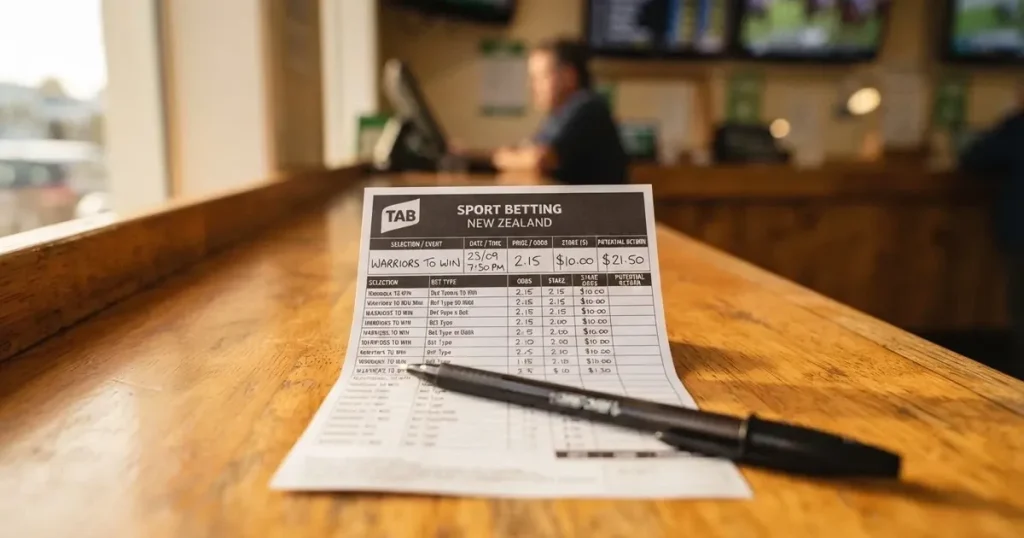
Current as of October 30, 2026 — verified against the Racing Industry Act 2020, the Racing Industry Amendment Act 2025, and TAB NZ’s published terms.
Arbitrage betting is the arithmetic of hedging every outcome of an event across bookmakers whose odds disagree. The premise is clean: if bookmaker A prices Team X at 2.10 and bookmaker B prices the draw at 2.10, a stake on each side returns more than it cost, regardless of the final score. The premise is also fragile. A 2012 study by Franck, Verbeek and Nuesch found that 98% of arbitrage opportunities returned less than 1.2% on turnover, which means the “projected profit” only materialises when the bettor moves large sums through tight windows. Bookmakers notice. Limits drop, accounts close, and in the worst cases half of the wager is cancelled after the event.
New Zealand sharpens the problem further. Since 28 June 2025, section 74AAA of the Racing Industry Act 2020 allows only TAB NZ and its online sister brand Betcha to take online racing and sports bets from people in New Zealand. There is no licence route for another bookmaker and no register to apply to, because there is only one lawful provider. A technique that needs several bookmakers cannot be run with lawful New Zealand providers alone. Everything that follows is the picture that produces: what the strategy asks of the maths, what New Zealand law allows, what offshore brands actually offer people here, and what each costs the reader who tries.
How Arbitrage Works: The Fundamentals
An arbitrage opportunity exists when the prices on every mutually exclusive outcome of an event imply probabilities that add up to less than 1. Decimal odds translate directly into implied probability: a price of 2.00 carries an implied chance of 50%, a price of 4.00 carries 25%. If one bookmaker posts 2.10 on the home win and another posts 2.10 on the away win, the implied probabilities sum to roughly 95.2% — leaving a 4.8% gap that, before the bookmaker’s margin is taken, looks like the bettor’s take.

Two things shape whether the gap is real. First, the gap is usually narrow. Most opportunities sit under 2% once the liquidity filter is applied, and a bettor who finds one without moving serious money captures almost nothing. The Franck, Verbeek and Nuesch study is the most cited reference here: the median opportunity returned roughly 1.2% of turnover, the long tail carried the rest, and most of the distribution sat below the threshold where a small bankroll can clear the bookmaker’s minimum bet.
Second, the gap closes fast. Odds move on information and on other arbitrage bettors staking into the soft side. A window that opens at 1.5% can close within minutes, and the closing process eats into the profit the bettor thought they had locked.
The Back-and-Lay Version
The cleanest version of arbitrage uses a betting exchange on one side and a traditional bookmaker on the other. The bettor backs Team X at a bookmaker for 2.20, then lays Team X at an exchange at 2.20 — meaning they accept someone else’s back bet, paying out if Team X wins but keeping the backer’s stake if Team X loses. The two positions cancel Team X’s outcome; the bettor is left with a position only on “not Team X”, which they have covered at favourable odds.

New Zealand has no lawful betting exchange. TAB NZ does not run one, and the offshore exchanges accessible from New Zealand (Betfair, Smarkets, and others) are themselves offshore operators serving a market they are not licensed in. A back-and-lay arb that uses an offshore exchange is, in New Zealand terms, the same kind of bet as an offshore sportsbook wager: the exchange is not a New Zealand-licensed venue, the New Zealand complaints framework does not reach it, and the player’s recourse runs through the exchange’s own terms.
Why Bookmakers Limit Arbitrage Bettors
Bookmakers do not need to prove that a customer is arbing to restrict them. The signal is behavioural: bets placed seconds before kick-off across a wide range of events, stake sizes that vary only to absorb different margins, accounts that never take a promotional offer. Once flagged, the account’s maximum stake drops sharply, sometimes to a few dollars. In older cases, half of an arbitrage bet was cancelled after the event and the stake returned; the practice is less common now but the contractual right to do so still sits in most bookmaker terms.
A bettor who plans to run arbitrage at scale needs many bookmaker accounts, an awareness of how each operator detects them, and a willingness to lose access to most of those accounts within months. The strategy’s economics depend on bankroll access, and bankroll access depends on staying undetected.
New Zealand’s Betting Monopoly: The Legal Landscape
The relevant law is short and recent. The Racing Industry Act 2020 makes TAB NZ the sole provider of racing and sports betting services to people in New Zealand. The Racing Industry Amendment Act 2025 inserted section 74AAA, which took effect on 28 June 2025: no person other than TAB NZ may offer racing betting, sports betting, or other racing or sports betting to a person in New Zealand, regardless of where that person is resident or incorporated. The Department of Internal Affairs told unlicensed providers serving New Zealand to withdraw with immediate effect when the amendment came into force.
TAB NZ runs two online brands: TAB itself and Betcha. They are one operator group, not rivals, and they share the same monopoly licence. Entain runs the TAB business under a 25-year agreement signed in 2023, with a 50/50 share of gross profits, at least NZ$150 million a year flowing to TAB NZ for the first five years, and a one-off NZ$100 million payment to the racing sector.
For a New Zealand resident who wants to bet on a sporting event with a licensed provider, the choice is between TAB and Betcha. For a New Zealand resident who wants to run an arbitrage strategy across several bookmakers, there is no licensed route at all. The strategy needs many bookmakers; the law permits one. That is the bind the rest of this page works inside.
What TAB NZ and Betcha Each Cover
TAB NZ is the legacy brand. Its app, TAB – Racing & Sports Betting, has been in the New Zealand App Store since 8 September 2014 under the seller name New Zealand Racing Board. The product covers thoroughbred, harness, and greyhound racing (greyhound racing is closing in stages from 1 August 2026), as well as a sports menu that runs from rugby union and league through football, cricket, basketball, tennis, and the major American codes. Fixed-odds bets and tote (pool) bets sit side by side, and bet types include Win, Place, Each Way, Quinella, Exacta, Trifecta, First Four, Double, Treble, Daily Double, Running Double, Quaddie, Big6, and Multis including Same Game Multis. Live betting is listed in the app; whether any statutory restriction narrows the in-play menu is not established.
Betcha is the newer brand, built around a social-betting model. Its daily Toolbox carries odds boosts and insurance tools for bets that do not land, its Bet Social section lets punters chat, follow tipsters, and share bets or pools, and its Playbook offers tips and match analysis. The product covers the same sports and racing codes as TAB, with the same underlying odds engine.
The Offshore Question
Overseas bookmakers that take bets from people in New Zealand are breaking New Zealand law under section 74AAA. The penalty for breaching the section is not stated in the legislation, and no prosecution of an offshore bookmaker under it has been published. Section 19(4) of the Gambling Act 2003 (inserted in 2025) says an individual may not be convicted for placing a bet with an offshore operator in breach of section 74AAA, so the player side carries no published criminal penalty.
What the player does carry is a list of stated risks from the Department of Internal Affairs: an offshore operator may sit in a jurisdiction with minimal consumer safeguards, may not return unspent credits, and may not pay out large wins. New Zealand’s harm-minimisation framework does not reach an offshore bookmaker; the Gambling Helpline and Safer Gambling Aotearoa do not have jurisdiction over them; and the self-exclusion tools that TAB NZ lists in its app do not flow through to an offshore account.
The honest framing is that TAB NZ and Betcha are the only lawful options, with New Zealand harm-minimisation tools, regulator oversight, and a complaints framework. Offshore brands are unlawful for the operator to serve New Zealand, with no New Zealand complaints route, the DIA’s stated risks, and limits or closures possible from the operator’s own side. Neither group is “the safe choice” by default.
Responsible Gambling Under a Monopoly
When one operator runs the whole market, the harm-minimisation picture simplifies. TAB NZ is required under the Racing Industry Act 2020 to keep the risks of problem and underage gambling minimised, and it pays a Problem Gambling Levy of 0.74% of its gross profits — a rate in force from 1 July 2025 to 30 June 2028. The levy funds treatment services and prevention work; it is not a fee the bettor pays.
The player-facing tools TAB NZ offers sit inside its apps. Deposit limits let a customer cap how much they can load onto the account over a chosen window; time-outs pause the account for a set period; self-exclusion closes the account for a longer term and is enforced across both TAB NZ brands. The age threshold for TAB NZ betting is 18, set under section 89 of the Racing Industry Act 2020; betting under 18 is an offence. Land-based casinos in New Zealand set the threshold at 20, and the two are separate regimes — a 19-year-old can be in a casino but cannot bet on TAB NZ’s products.
Help outside the operator sits with the free Gambling Helpline on 0800 654 655 (text 8006) and Safer Gambling Aotearoa. The helpline is the route for someone who feels their betting is moving in a direction they did not choose. TAB NZ’s app lists the number alongside the in-app tools, and the same number appears in the gambling-harm information the Department of Internal Affairs publishes.
What the framework does not include is a single national online-betting exclusion register. The register the new online casino law will require is for online casinos only, and does not extend to TAB NZ or Betcha; self-exclusion at TAB NZ applies across its two brands but does not block offshore operators. A bettor who wants to be excluded from gambling entirely in New Zealand needs to manage that through TAB NZ’s tools and through their own decisions about offshore platforms.
What the Framework Does Not Cover
Offshore bookmakers are outside the harm-minimisation framework. They are not required to offer deposit limits, time-outs, or self-exclusion to New Zealand customers, and the regulator cannot enforce those requirements on them. The bettor who uses an offshore brand checks the operator’s own terms for what is available, and treats the absence of those tools as a feature of the platform rather than a defect.
Arbitrage betting also sits in a grey zone for the responsible-gambling framework. The bettor’s activity looks like normal market coverage from the operator’s perspective — small bets, no chasing, no escalation — but the underlying motive is mechanical rather than recreational, and the size of the turnover the strategy demands can dwarf the bettor’s other betting. A bankroll designed to clear NZ$10,000 a week of turnover at 1% net margin is not a casual bankroll, and a bettor running one needs to decide what they must do if a single account is closed mid-cycle with funds still inside.
Crypto and Pseudonymous Betting
The Offshore brands that crypto arbitrage hinges on. New Zealand law says nothing about crypto as a payment method for betting, and TAB NZ’s deposit methods come only from its own terms; no statute governs whether a New Zealand resident may fund a TAB NZ account with Bitcoin, and TAB NZ does not list crypto among its accepted deposit methods. Account opening at TAB NZ requires a verified New Zealand address and ID, so a fully pseudonymous account is not available there.
Offshore platforms that do accept crypto — Roobet, BetNinja, and the broader Soft2Bet group — carry their own permissions. Roobet is a brand name of Raw Entertainment B.V., registered in Curaçao under licence OGL/2024/687/0427, which gives the operator no right to take bets from people in New Zealand. BetNinja states it is licensed by the Union of the Comoros. Other brands in the same set — 22Bet (Curaçao 8048/JAZ), Rabona (Curaçao), Golden Panda (no New Zealand-applicable licence named) — sit in similar positions: a foreign licence that does not authorise New Zealand service, and the offshore operator’s own terms as the only contract that applies.
For arbitrage bettors, the appeal of crypto funding is speed and reach. Crypto deposits settle quickly, do not run through a New Zealand bank, and can be moved between exchanges and betting platforms with the bettor managing the on-chain side themselves. The cost is the absence of New Zealand recourse. A dispute over a cancelled bet, an unreleased withdrawal, or a closed account with funds inside runs through the operator’s own complaints process, and the offshore licence under which the operator sits is the only external route if that process fails. New Zealand’s harm-minimisation framework does not reach a Curaçao-licensed operator, and the consumer protections the operator’s home regulator offers may not be the protections a New Zealand bettor expects.
Crypto also changes the volatility calculation. Bitcoin’s price can move several percent in an hour, and an arbitrage position that locks in a 1% bookmaker margin while the crypto side moves 3% against the bettor does not lock in any profit at all. A bettor using crypto funding needs to account for the funding-leg movement separately from the betting-leg margin, and the simple “this returns 1% regardless of outcome” framing does not hold when the funding itself is a volatile asset.
Predictions, Strategy, and the Search for Today’s Arb
The marketing word is “arb today”: a list of opportunities, a screen of soft prices, a stake split that returns the same regardless of result. The reality is that arb opportunities appear in narrow windows and disappear faster than most retail tools can capture them. The Franck, Verbeek and Nuesch distribution shows why: the median opportunity returns less than 1.2%, the tail is short, and the bettor who finds an opportunity late in its life has usually lost most of the edge to the closing odds.
The strategy side breaks into two questions. First, how does a bettor find the opportunities? Real arb finders run odds feeds from dozens of operators and run them through an implied-probability filter the moment the data lands. The latency between the feed and the bet is the bettor’s edge, and the bettor who works from a website refresh is working at a latency the market has already closed. Second, how does a bettor size the stakes? The stake split is the inverse of the odds: on a 2.10 / 2.10 market with a NZ$1,000 total stake, the bettor stakes NZ$476.19 on each outcome. A NZ$1,000 stake returns NZ$1,000 if either side wins, and the NZ$47.62 difference is the profit. The stake split must be exact, and any rounding error on the bettor’s side is a direct loss.
Why Tips and Forecasts Do Not Beat the Maths
Tipsters and prediction services sell forecasts. Forecasts are opinions on outcomes, not prices on outcomes, and the two tips tips are different. A tipster who says Team X wins at 60% is making a probability claim; a bookmaker who says Team X wins at 2.10 is making a 47.6% probability claim. Where the tipster’s probability is higher than the bookmaker’s, the bet is +EV. Where the tipster’s probability is the same as the bookmaker’s, the bet is a coin flip with the operator’s margin taken off the top.
Arbitrage betting does not need a forecast at all. The strategy returns the same amount regardless of which outcome occurs, so the bettor’s view on the result is irrelevant. The view that matters is whether the prices still imply a gap when the bettor reaches them, and that view is a market view, not a sporting view.
The Bankroll Question
The 1% median margin means the bettor needs a bankroll large enough that 1% of turnover is meaningful. A NZ$1,000 bankroll turning over NZ$10,000 a week at 1% returns NZ$100 before any consideration of the bettor’s time, the cost of the tools, and the cost of accounts that get limited. A NZ$100,000 bankroll turning over NZ$1 million a week at 1% returns NZ$10,000, and the operating cost of running that turnover is meaningful but not crushing.
The bankroll also needs to be split across accounts. A single bookmaker account cannot capture both sides of an arbitrage, and the bettor’s exposure to account closures means a meaningful fraction of the bankroll sits at risk of being trapped inside a closed account at any time. A bettor running NZ$100,000 across eight bookmakers has NZ$12,500 in each, and the closure of any one account is a recoverable but real cost.
Bet Types, Odds, and the Margin Inside Every Price
The numbers behind arbitrage betting are the same numbers behind every other form of betting. Decimal odds translate into implied probability by dividing 1 by the odds: 2.00 is 50%, 4.00 is 25%, 1.50 is 66.7%. The bookmaker’s margin is what is left when the implied probabilities of every outcome of a market sum to more than 100%. A two-way market priced at 1.90 / 1.90 implies 52.6% on each outcome, summing to 105.3%. The 5.3% excess is the bookmaker’s margin — the share of every dollar bet on that market that the operator keeps on average.
The margin can be stated two ways. As a payout share, the market returns 94.7% of every NZ$1 bet on it. As a margin, the market keeps 5.3% of every NZ$1 bet. Both numbers describe the same market; neither is more accurate than the other. The cleanest way to read them is that the bookmaker’s margin is the gap between the true probabilities of the outcomes and the implied probabilities in the prices.
Reading the Margin in a Real Market
A worked example with an illustrative two-way market at decimal odds of 1.90 and 1.90: the implied probability of each outcome is 1 / 1.90 = 52.6316%. Summing the two gives 105.2632%. The payout share is 1 / 1.052632 = 95.0% (to the nearest whole percent, since each outcome carries the same price), and the margin is 1 − 0.9500 = 5.0%. So a NZ$1,000 stake across both outcomes returns NZ$950 in expectation — the bettor loses NZ$50 of every NZ$1,000 to the operator’s edge before considering which outcome actually wins.
The same calculation on a tighter price tells a different story. At 1.95 / 1.95, the implied probabilities sum to 102.6%, the payout share is 97.5%, and the margin is 2.5%. At 1.98 / 1.98, the margin is 1.0%. The thinner the margin, the closer the market is to “true” probabilities, and the smaller the operator’s edge per dollar bet. Arbitrage bettors depend on thin margins because thin margins mean the gap between two operators’ prices is more likely to exceed the combined margins and produce a real arb.
How a Combination Bet Changes the Math
A combination bet (also called an accumulator or multi) prices each leg individually and multiplies the odds together. Two legs at 1.90 / 1.90 combined give a price of 3.61 on the multi. The implied probability of the multi winning is 27.7%, against the true probability of both legs winning (52.6% × 52.6% = 27.7% if the outcomes are independent and the prices are fair). The margin on the multi is the gap between the combined individual margins and the multi’s implied margin — usually larger than either single leg’s margin, because each leg carries its own margin and the multi compounds them.
For arbitrage purposes, combination bets are a different problem. A two-way single market is the cleanest arb, with one price on each side and a clear stake split. A multi with three legs needs prices on all three outcomes of all three events, and the bettor’s exposure to any one outcome being mispriced at the multi level is larger. Same Game Multis — a multi whose legs come from one event — sit in the middle, and bookmakers often run tighter margins on SGMs than on cross-event multis.
What the Return on a Winning Bet Looks Like
The arithmetic of a single winning bet is straightforward. A NZ$100 stake at decimal odds of 2.50 returns NZ$250, with NZ$150 as net profit (the NZ$100 stake plus NZ$150 of winnings). A NZ$100 stake at 1.50 returns NZ$150, with NZ$50 as net profit. The decimal odds carry the stake and the profit together; the fractional odds used in some markets carry only the profit, and the bettor adds the stake back separately. New Zealand uses decimal odds on TAB NZ’s platforms; offshore operators vary, with some offering American (+100 = even money) and fractional (1/1 = even money) formats as alternatives.
For a combination bet, the multiplication is the same: a NZ$10 stake at combined odds of 5.50 returns NZ$55, with NZ$45 as net profit. The bettor needs all legs to win for the bet to pay out; a single losing leg voids the entire stake.
The Bookmakers: Reviewed Against the New Zealand Reality
What follows is a reference list of brands a New Zealand reader meets. TAB and Betcha are the two lawful options; the rest are offshore brands not licensed in New Zealand. Each is rated against the same criteria: what they offer, what they charge, and what New Zealand reality they fit. This is not a ranking and not a recommendation. TAB and Betcha are not in competition with the offshore brands, because the offshore brands are not lawfully serving New Zealand.
TAB
TAB is one of the two online brands of TAB NZ, the only provider lawfully offering racing and sports betting to people in New Zealand under section 74AAA of the Racing Industry Act 2020. The product runs from thoroughbred, harness, and greyhound racing (greyhound closing from 1 August 2026) through rugby union, rugby league, football, cricket, basketball, tennis, and the major American codes. Fixed-odds and tote (pool) bets sit side by side, and bet types include Win, Place, Each Way, Quinella, Exacta, Trifecta, First Four, Double, Treble, Daily Double, Running Double, Quaddie, Big6, and Multis including Same Game Multis. Live betting is in the app; the specific in-play menu is the bettor’s check at the time of betting.
Deposit limits, time-outs, and self-exclusion are available in the TAB – Racing & Sports Betting app. The 18+ age threshold applies, with verified New Zealand address and ID required at account opening. Help sits behind the Gambling Helpline number 0800 654 655 and text 8006, both of which TAB NZ lists in its app.
TAB is the right venue for a New Zealand bettor who wants the only lawful route, with the full New Zealand harm-minimisation framework behind it, and who is content with one bookmaker’s prices. It is the wrong venue for arbitrage betting, because one bookmaker cannot run both sides of a position.
Betcha
Betcha is the second online brand of TAB NZ and shares the same monopoly licence as TAB. Its product covers the same sports and racing codes, but the surface is built around social betting. The daily Toolbox carries odds boosts and insurance tools for bets that do not land; the Bet Social section lets punters chat, follow tipsters, and share bets or pools; the Playbook offers tips and match analysis.
The harm-minimisation framework behind Betcha is the TAB NZ framework: deposit limits, time-outs, self-exclusion, the 18+ threshold, verified identity, the Gambling Helpline. Self-exclusion at TAB NZ applies across both brands.
Betcha suits a New Zealand bettor who wants TAB NZ’s product but with a social layer on top. The odds engine sits behind the same prices TAB offers, so the bettor comparing Betcha to TAB is comparing surfaces rather than prices. Arbitrage betting is not a fit for the same reason TAB is not a fit: one operator cannot run both sides of the position.
Glorion
Glorion is an unlicensed offshore operator. The site accepts customers over 18 years of age only and offers support by live chat and email. Local protections do not apply. Section 74AAA makes it unlawful for Glorion to take sports or racing bets from a person in New Zealand; the operator’s own terms are the only contract that applies.
A New Zealand reader who reaches Glorion is advised to treat it as an offshore platform with no local protections. The platform may offer features New Zealand-licensed brands do not, and those features carry the risks DIA has flagged.
BillyBets
BillyBets is an unlicensed offshore operator. Its sports menu carries odds in three formats — decimal (2.00), American (+100), and fractional (1/1) — and its sportsbook offers cashback and reload bonuses alongside a coin shop where coins collected from depositing, tournaments, and challenges can be exchanged for free bets and free spins. The VIP programme has five levels.
The licence behind BillyBets does not extend to New Zealand. Local protections do not apply, and the operator’s terms govern the experience exclusively.
Roobet
Roobet is an unlicensed offshore operator. The brand is operated by Raw Entertainment B.V., registered in Curaçao under licence OGL/2024/687/0427. The Curaçao licence does not authorise Roobet to take bets from people in New Zealand. Local protections do not apply.
Roobet accepts crypto as a funding method, which sets it apart from New Zealand-licensed platforms on the payment-method side. The bettor’s exposure to crypto-side volatility and to offshore-licence recourse is the trade-off. The 24/7 sportsbook and casino product run on the same account, and the bettor’s deposit, withdrawal, and dispute paths go through the Curaçao-licensed entity.
22Bet
22Bet is an unlicensed offshore operator. The licence behind it is Curaçao 8048/JAZ, held by TechSolutions Group N.V. The platform takes single bets, accumulators, systems, and chains, and offers live betting with real-time odds and score updates. The bet types run wider than a traditional sportsbook, and the live-betting menu is one of the deeper ones in the offshore set.
The licence does not authorise 22Bet to take bets from people in New Zealand. Users have no recourse to New Zealand authorities, making the platform’s own terms the final authority.
Rabona
Rabona is an unlicensed offshore operator. The site launched on 23 December 2019 as the sixth online sportsbook of the Soft2Bet group, which holds a Curaçao licence. The licence does not authorise Rabona to take bets from people in New Zealand.
Rabona sits in the same Soft2Bet group as several other offshore brands; the bettor who moves between them is moving within one operator’s network, and the platform-level tools and protections are the network’s tools and protections. No New Zealand complaints route or harm-minimisation framework reaches Rabona.
Golden Panda
Golden Panda is an unlicensed offshore operator. The platform publishes dedicated Sports Terms and Conditions that cover fixed-odds betting, Combo Bets, the Bet Builder feature, live scoreboards and broadcasts, and stake and odds limits. The published terms are unusually thorough for an offshore operator, which is useful to a bettor who reads them.
The platform names no licence that applies in New Zealand. Users must navigate the platform’s terms without the support of a New Zealand regulator.
BetNinja
BetNinja is an unlicensed offshore operator. The platform states it is licensed by the Union of the Comoros. The Comoros licence does not authorise BetNinja to take bets from people in New Zealand, and the licence’s standing as a regulator is not comparable to a tier-one jurisdiction.
The operator provides no local support tools, so users accept all risks outlined in the site terms.
FunBet
FunBet is an unlicensed offshore operator. Its sportsbook offers odds on football, ice hockey, American football, basketball, volleyball, tennis, rugby, and baseball, with live betting and a bookmaker described as open 24/7. The platform names no licence that applies in New Zealand.
No New Zealand complaints route or harm-minimisation framework reaches FunBet. A New Zealand bettor using the platform checks the operator’s own terms for what tools and protections are on offer. The 24/7 framing is a marketing claim; the bettor who plans to bet at 3 a.m. checks the platform’s actual uptime before relying on it.
The Comparison at a Glance
| Brand | New Zealand status | What the operator’s own terms state |
|---|---|---|
| TAB | TAB NZ brand (sole lawful online provider) | Deposit limits, time-outs, self-exclusion; 18+ with verified NZ ID; fixed-odds and tote; racing and sports menu |
| Betcha | TAB NZ brand (sole lawful online provider) | Same TAB NZ framework; daily Toolbox with boosts and insurance; Bet Social and Playbook |
| Glorion | Not licensed in New Zealand | 18+ only; support by live chat and email; offshore platform terms |
| BillyBets | Not licensed in New Zealand | Decimal, American, and fractional odds; cashback and reload sports bonuses; coin shop and five-level VIP |
| Roobet | Not licensed in New Zealand | Curaçao licence OGL/2024/687/0427 (Raw Entertainment B.V.); crypto funding; 24/7 sportsbook and casino |
| 22Bet | Not licensed in New Zealand | Curaçao licence 8048/JAZ (TechSolutions Group N.V.); singles, accumulators, systems, chains; live betting |
| Rabona | Not licensed in New Zealand | Curaçao licence (Soft2Bet group); launched 23 December 2019 |
| Golden Panda | Not licensed in New Zealand | Sports Terms and Conditions cover fixed-odds, Combo Bets, Bet Builder, live scoreboards, stake and odds limits |
| BetNinja | Not licensed in New Zealand | Comoros licence; offshore platform terms |
| FunBet | Not licensed in New Zealand | Sportsbook on football, ice hockey, American football, basketball, volleyball, tennis, rugby, baseball; live betting; 24/7 |
The table is not a recommendation. TAB and Betcha are the lawful options; the rest are offshore brands New Zealand readers encounter, each marked for what they offer and what they lack. The right column names what each operator publishes about itself; what the operator does not publish is the bettor’s check at the betting slip.
How to Read This Page in Practice
Three threads run through the material above, and the reader who takes the page seriously is advised to hold them separately.
The first is the maths. Arbitrage betting returns the same amount regardless of outcome, but the margin is thin, the window is narrow, and the bankroll has to be large enough that thin margins on large turnover mean anything. The bettor who plans to run arbitrage from a New Zealand base is competing with operators who know the strategy, who watch for it, and who close accounts that look like it.
The second is the law. Section 74AAA permits only TAB NZ to take racing and sports bets from people in New Zealand. The offshore brands that arbitrage requires are not lawfully serving New Zealand, and the player carries the DIA’s stated risks with no New Zealand complaints route behind them. The lawful path is one bookmaker, and one bookmaker does not run both sides of an arb.
The third is the protection. New Zealand’s harm-minimisation framework sits inside TAB NZ. Deposit limits, time-outs, self-exclusion, the 18+ threshold, and the Gambling Helpline are real tools with real enforcement. The offshore platforms are outside that framework, and the bettor’s protections are whatever the operator’s own terms happen to say. The choice to use an offshore brand is a choice to step outside the framework, and the reader who makes that choice is advised they have made it.
The strategy, the law, and the protection each push in different directions. The maths is real but small; the law narrows the lawful options to one; the protection sits inside the one lawful option. A reader who weighs all three is not looking at arbitrage as a money-making strategy — they are looking at it as a description of a strategy that exists in theory, costs the bettor more than it looks, and is mostly run from places where New Zealand law does not follow.
Frequently Asked Questions
Does sports arbitrage betting work?
Arbitrage betting works in the arithmetic sense: if the prices on every outcome of an event imply probabilities summing to less than 1, a stake on each outcome returns more than it cost regardless of result. It works less well in the practical sense: most opportunities return less than 1.2% on turnover, bookmakers detect and limit accounts that take them, and the bankroll needed to clear meaningful money from thin margins is large.
How does someone set up an arbitrage bet?
A bettor finds an event where two or more bookmakers price the mutually exclusive outcomes at a combined implied probability below 100%. The bettor stakes on each outcome in proportion to the inverse of its odds. The stake split must be exact, and any rounding error is a direct loss. The bettor’s edge depends on the prices still being soft when the bets land.
What is the practical sequence for placing an arbitrage bet?
The bettor opens a calculator, plugs in the odds on each outcome, and reads off the stake percentages. They open each bookmaker’s slip, enter the stake, and confirm each bet before the prices move. They repeat across enough events per week that the turnover builds into meaningful profit. They expect accounts to be limited within months.
Which bookmaker may lawfully take sports and racing bets in New Zealand?
TAB NZ, through its two online brands TAB and Betcha, is the only provider lawfully offering racing and sports betting to people in New Zealand under section 74AAA of the Racing Industry Act 2020, in force since 28 June 2025. No other operator holds a New Zealand betting licence, and the law does not block offshore websites; it puts liability on the offshore operator.
How is the return on a bet worked out from the stake and the odds?
The return on a winning bet is the stake multiplied by the decimal odds. A NZ$100 stake at decimal odds of 2.50 returns NZ$250, with NZ$150 as net profit. A combination bet multiplies the odds of each leg into one combined price; a NZ$10 stake at combined odds of 5.50 returns NZ$55.
What is the bookmaker’s margin and how can it be seen in the odds?
The bookmaker’s margin is what is left when the implied probabilities of every outcome of a market sum to more than 100%. A two-way market priced at 1.90 / 1.90 implies 52.6% on each outcome, summing to 105.3%; the 5.3% excess is the operator’s edge. The same market’s payout share is 95.0%, meaning a NZ$1 bet returns NZ$0.95 on average.
Tips & strategy – cryptobetsnz
Content created by the «cryptobetsnz» team
